Friday, January 25, 2013

The Richards Piano Quartet play Chausson and Martinu


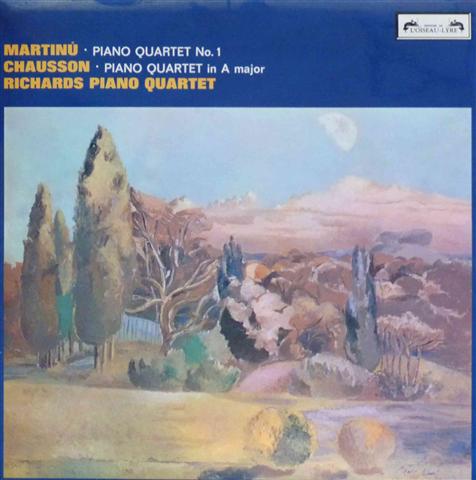
Regular readers of this blog know that I have a soft spot for chamber music. Here's a very fine L'Oiseau Lyre lp c 1969 featuring the Richards Piano Quartet (named after founder-cellist Bernard Richards) performing the Piano Quartet in A of Chausson and the first piano quartet of Martinu. Indeed, very different styles these two composers, but it works well for the musicians are all top notch (the pianist is the well regarded Bernard Roberts) and they are sensitive to the contrasts between the styles of both composers. Chausson, of course, inhabits that lush world of late 19th century France while Martinu incorporates that spiky, almost jazzy quality that appeared during the 1920's. Neat stuff all around.

I could find no evidence that this record has been issued on cd. What a shame! I guess the Richards Piano Quartet did not have that kind of sexy quality that you get when you throw Barenboim, Zuckerman, Argerich...you get the idea, in the room together.


DOWNLOAD PART 1

DOWNLOAD PART 2

Thursday, January 17, 2013

Charles Munch conducts Martinu and Piston


Here's a transfer on request. I have uploaded the monaural LM series lp of Charles Munch and the BSO in the sixth symphonies of both Walter Piston and Bohuslav Martinu. Typical Munch here, exciting and bracing, full of raw energy. I wish Munch had recorded more by these two composers. He would have made a compelling Martinu cycle, I'm sure.

These recordings date from 1957 I believe.

DOWNLOAD

Wednesday, January 16, 2013

Beveridge Webster plays Rachmaninoff


Someone was looking for Beveridge Webster playing just about anything and well, they are in luck. Webster hypnotically guides the listener through the Etudes Tableaux of the great Rachmaninoff on this mid 60's Dover issue.

From Wikipedia:

Rachmaninoff composed the Op. 33 Études-tableaux at the Ivanovka estate between August and September 1911, the year after completing his second set of preludes, Op. 32. While the Op. 33 Études-tableaux share some stylistic points with the preludes, they are actually very unlike them. Rachmaninoff concentrates in the preludes on establishing well-defined moods and developing musical themes. There is also an academic facet to the preludes, as he wrote 24 of them, one in each of the 24 major and minor keys. Rachmaninoff biographer Max Harrison calls the études-tableaux "studies in [musical] composition"; while they explore a variety of themes, they "investigate the transformation of rather specific climates of feeling via piano textures and sonorities. They are thus less predictable than the preludes and compositionally mark an advance" in technique. Like the piano études of Claude Debussy, Alexander Scriabin, Olivier Messiaen and György Ligeti, the Études-tableaux "summarize their composers' discoveries about the piano and how music for it should be written." Rachmaninoff initially wrote nine pieces for Op. 33 but published only six in 1914. One étude was subsequently revised and used in the Op. 39 set; the other two appeared posthumously and are now usually played with the other six. Performing these eight études together could be considered to run against the composer's intent, as the six originally published are unified through "melodic-cellular connections" in much the same way as in Robert Schumann's Études Symphoniques.

The Op. 39 set of Études-tableaux, written between 1916 and 1917 and published in 1917, was the last substantial composition written by Rachmaninoff while still in Russia, and it shows a marked departure from his previous work. Rachmaninoff had been listening keenly to his contemporaries Scriabin and Sergei Prokofiev, and had studied Scriabin's works to prepare a memorial recital in which Rachmaninoff himself played in Scriabin's honor. Though he was roundly criticized for his overly-analytical approach in his playing and overall lack of capturing the free-flying spirit that Scriabin had summoned so well in his own pianism, the compositional seeds resulting from his studying Scriabin's work had been planted. A melodic angularity and harmonic pungency appeared in these études as well as in his Op. 38 songs, which were written concurrently. The Op. 39 set is considered much more demanding technically than the Op. 33 set, and has been described as extremely virtuosic in its approach to keyboard writing, calling for unconventional hand positions, wide leaps for the fingers and considerable technical strength from the performer. Also, "the individual mood and passionate character of each piece" pose musical problems that preclude performance from those not possessing a tremendous physical technique.

Indeed, one must be a confident and technically assured musician to tacke these pieces and we need not worry where Beveridge Webster is concerned. His stylistic playing is beyond reproach and on display is the most tasteful of musicianship.

DOWNLOAD PART 1

DOWNLOAD PART 2

Wednesday, January 9, 2013

Rene Leibowitz leads Schoenberg's Gurrelieder


I'm very, very happy to have found the VoxBox of this original Haydn Society record. Rene Leibowitz leads French forces in one of the greatest recordings of Gurrelieder ever made. making allowances for somewhat muffled early 50's sound, this performance will convince you that this masterpiece is the product of one of the greatest musical geniuses of all time.

Conductor Leibowitz was the ideal choice to invest the task of bringing Gurrelieder to life. He was long associated with Schoenberg and the second Viennese School of composition (note Gurrelieder is exclusively tonal)  and his commitment to this sprawling, complex masterwork is totally without question. Leibowitz creates a continual line which navigates this work through its monumental length and thick orchestration. The conductor is so utterly convincing and absorbing that all I can say that oh, what magic Leibowitz would have worked with Mahler. Many have used Wagner to describe Gurrelieder but it is most assuredly Mahler and his sound world that serve as an inspiration for this choral and orchestral blockbuster.

This is an essential record, a tribute to the great gifts possessed by Rene Leibowitz.

DOWNLOAD PART 1

DOWNLOAD PART 2

Saturday, January 5, 2013

Carl Bamberger conducts Brahms' Ein Deutsches Requiem


Happy New Year! Been a few weeks since I posted. The busy days around the holidays were followed by a week of a nasty bug which left me with just enough energy to make my way into the office. Ho hum....

To start the new year, I'm offering a wonderful performance, on Nonesuch, of one of my favorite works by any composer, namely the German Requiem of Brahms. Here, the proceedings are directed by the fine German conductor Carl Bamberger. I must tell you that hearing Teresa Stitch-Randall's brief contribution  is worth the admission alone as her lovely, disciplined voice, that excelled in this repertoire, justs grabs your heart and melts your resolve. Gorgeous!

The orchestra, and especially the chorus, give full bodied, urgent accounts of their parts and overall, the effect of the music making is vital and dramatic This might not be the most polished performance but I don't think that would matter to Brahms; the overall product conveys the very human aspect of the work as the composer himself intended.

As a bonus, and to fill better two cds, I transferred a very early Simon Preston Argo lp where he leads the New English singers in motets and he, himself offers up some first rate organ playing too.

Both records are in stereophonic sound.


Saturday, December 15, 2012

Happy Holidays to All My Followers


To All My Loyal Followers:

As a Holiday sign of appreciation to you, I am offering the contents of a folder containing transfers made throughout the year. Some of the items have made it to post while others have not. For each item, I reference the lp label and catalog number for easy search on the internet.

It's been an uncertain year, what with shaky economic news and tragedies like the one that just played out in Connecticut. Hopefully some of this music that I offer will bring comfort and joy. Music represents humanity at its most creative, inspired and noblest force. Music reminds us that however flawed we are, we are all made in God's image.

Happy Holidays to you all!

Fred

DOWNLOADS

Friday, December 7, 2012

Baroque Program with the Societa Corelli


Back in the 1950's, RCA Victor released a handful of records featuring the chamber orchestra of Societa Corelli. Here is LM 1767, a nice program which alternates soprano arias with concerti grossi of the time.

The following piece are featured on this lp:

ANTONIO VIVALDI - 1) Concerto in A minor, 2) Cessate Omai for mezzo soprano and Strings and,
3) Sinfonia No. 2 in G major

BENEDETTO MARCELLO - Concerto grosso in F major op. 1 No. 4

GIACOMO CARISSIMI - Suonerà l'ultima tromba

FRANCESCO GEMINIANI - Concerto grosso in E minor op. 3 No. 3


Luisa Ribacchi  is the mezzo soprano and she acquits herself well in this repertoire.

I'd call this lp one of those records found on the byways of music. It was probably quite a novelty at the time and catered to people's perception that the Italian Baroque would receive authoritative performances by Italian ensembles.

DOWNLOAD

Monday, November 26, 2012

Beethoven and Chopin played by Istvan Nadas


Two Period label lp's are highlighted featuring the 10 insightful fingers of Hungarian born pianist, Istvan Nadas. Practically forgotten today, he like Marian Filar, was able to overcome significant trials in a concentration camp and become a respected soloist and teacher of the keyboard.  Here's what the www.bach-cantatas.com has to say about him:

The Hungarian pianist, István Nádas, began his musical studies at the age of 10. He studied piano under Louis Kentner and Béla Bartók, composition under Zoltan Koday and chamber music under Leó Weiner.

Once launched on his career as concert pianist, he appeared frequently with the Budapest Philharmonic Orchestra, his repertory including standard works in addition to less usual ones by B. Bartók, Igor Stravinsky, and Arthur Honegger. Until the beginning of World War II, István Nádas toured Europe extensively, but with the beginning of hostilities he had the misfortune to be put into a German concentration camp. His bitter experience left its marks, but did not take from him the ability or desire to continue his career.

After the end of the war István Nádas appeared at the Bach Festival in Rome and won a high decoration from the Italian government. Then came the decision to settle in Venezuela where he became head of the Post-graduate Piano Course at the National Conservatory of Music. There followed numerous recitals in South and Central America. As a citizen of Venezuela, Nádas represented his adopted country at the International Music Festival in Venice, playing for the first time in Europe a recital composed entirely of modern Venezuelan composers.

Since 1953, at the invitation of Xavier University of Louisiana, István Nádas has been teaching piano master-classes at this university. He has appeared as soloist several times with the New Orleans Philharmonic Orchestra under Alexander Hilsberg. On the occasion of his New York Town Hall concert on October 5, 1954 the critics were enthusiastic about his “technique, musicianship, breadth of taste, freshness and individuality of vision,” his “ease and dramatic poetry,” his “tenderness, sensitive tone adjustments.” To a man they were amazed at the fact that “in a program that would have tested the capacities of the giants of the keyboard he more than held his own.” The contents of this formidable program in which Nádas distinguished himself included a J.S. Bach Partita, L.v. Beethoven’s Hammerklavier Sonata, a Prokofieff Sonata, a Chopin Ballad and DeFalla’s Baetica. Among his recordings are L.v. Beethoven Piano Sonatas (The Tempest, The Appassionata and the Les Adieux) on Period Records, Schubert: Wanderer Fantasie and Moments Musicaux on Period Records, J.S. Bach: Two and Three Part Inventions (BWV 772-801) on Repertoire Records, J.S. Bach’s Well-Tempered Clavier Books I +11 (BWV 846-869, BWV 870-893) on Repertoire Records and 2 Volumes on Period Records of Contemporary composers. He was most famous for his performances of the cycle of the complete 32 L.v. Beethoven Sonatas and cycle of the complete L.v. Beethoven Concerti. He was an outstanding Bach specialist who performed many times at the famous Carmel Bach Festival in Carmel, California.

István Nádas was a Professor of Piano at San Francisco State University from 1965 to 1968. From there he founded the Doctoral Program in Piano at Washington State University, continued to travel and concretize throughout the world including the program in music at Grass Valley Nevada. He subsequently took a teaching position in Mexico City, Mexico and spent much time in Italy and Europe. He passed away quietly in Mexico in the year 2000.  

DOWNLOAD BEETHOVEN - PERIOD SHO328

DOWNLOAD CHOPIN - PERIOD SPL722
Tuesday, November 20, 2012

Leonard B Smith Plays the Cornet


Something a little different today. As my son is learning the trumpet, following in my footsteps..haha.., I went a diggin' and discovered this fine solo record played by famed cornetist Leonard B Smith. Here, we have a nicely arranged program (from Corelli to Clarke) which is varied in content and immaculately executed by one of the finest brass players of the previous century.

For those that don't know Leonard B Smith, I'll fill you in. Native of New York, the bulk of his career was spent in Michigan as principal trumpet of the Detroit SO, conductor of the famed Detroit Concert band and esteemed teacher and clinician. For many years, Smith also commuted back to New York for his role as solo cornetist with the illustrious Goldman Band. Leonard Smith, it is important to note, is in that line going back to Herbert L Clarke and Patrick Gilmore and he is considered to be the last great practitioner of the cornet, the smaller, gentler version of a modern Bb trumpet, you could say.

Smith plays in a style which has long past, one where the music is the most important part for the program and the artist is the mouthpiece for it. His playing is honest, true, unfussy and crystalline. By any stretch, this is a recital which is well thought out, well judged and very well played. Smith is admirably joined by pianist Bernard Leighton.

I encourage you to have a listen, you will not be disappointed. This series, "Award Artists" was produced by the legendary Enoch Light. I'm guessing the recording is from the early 60's though it is monaural.
DOWNLOAD

Followers